
Your Org Chart Is Not the Problem
Most reorganizations fail because leadership moves people around without fixing the decisions, communication, authority, and pressure patterns that made the company dysfunctional in the first place.
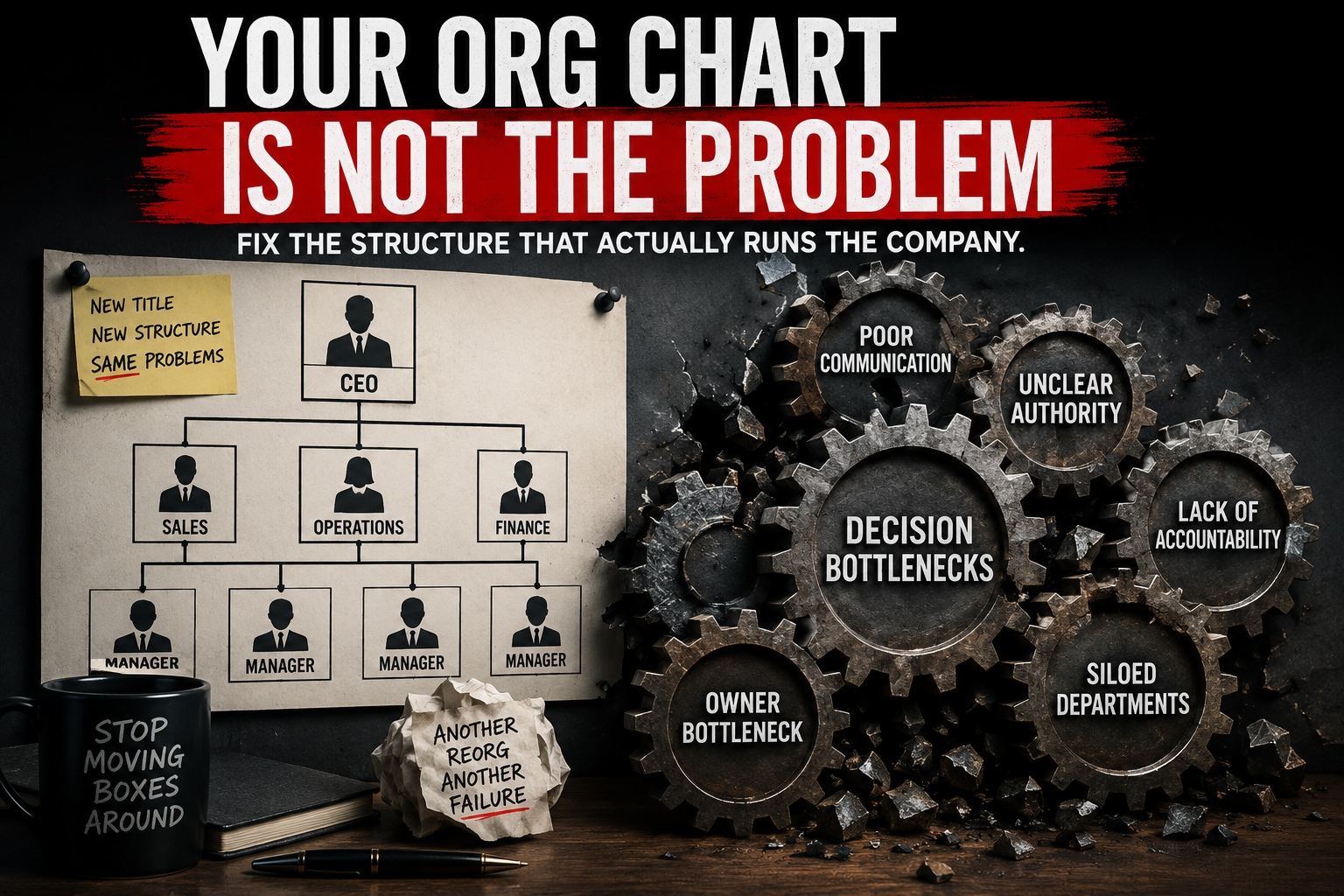
Most companies do not need a prettier org chart. They need the business to start telling the truth. Moving one manager under another manager does not fix weak leadership. Changing titles does not fix unclear authority. Creating a new department does not fix bad communication. Replacing one box with three smaller boxes does not fix the fact that every important decision still gets dragged back to the owner.
That is why so many business reorganizations look productive for thirty days and then quietly collapse back into the same old structure. The names change, the reporting lines change, somebody gets promoted, somebody gets moved, and a new chart gets presented. Everybody nods, then the same bottlenecks return. The same people still wait for permission. The same decisions still stall. The same departments still blame each other. The same managers still avoid conflict. The same owner still gets pulled into everything.
The org chart was never the real problem. The real problem was how the company actually operated.
Why Business Reorganizations Fail
A business is not organized by what the boxes say. It is organized by where decisions go, who owns the outcome, how fast information moves, what happens when standards are missed, and whether people have the authority to solve the problems they are responsible for. That is the operating structure, and in a lot of companies, the operating structure is completely different from the org chart.
On paper, the sales manager runs sales. In reality, the owner approves every meaningful decision. On paper, the operations director owns delivery. In reality, nobody moves until three people agree. On paper, the department heads are accountable. In reality, poor performance gets discussed, explained, softened, and tolerated. That is not organization. That is confusion wearing titles.
Business reorganizations fail when leadership treats structure like furniture. Move this person here. Put that department there. Create another layer. Change the title. Add a meeting. Rename the role. None of that matters if the actual behavior stays the same.
If the owner still overrides managers, the managers are not leading. If employees still need permission for routine decisions, authority has not been delegated. If departments still protect themselves instead of solving the company’s problem, the business is still fragmented. If nobody knows who owns the final result, accountability does not exist. A real business reorganization has to change the flow of responsibility.
The Decision Bottleneck
The fastest way to understand a dysfunctional company is to follow the decisions. Where do they stop? Where do they get repeated? Where do they wait? Where do they get reversed? Where do they keep returning to the same person? That tells you more than the org chart ever will.
A decision bottleneck happens when the company has responsibility without authority. People are expected to produce results, but they cannot make the decisions required to produce them. So they wait. They send another email, schedule another meeting, ask for approval, protect themselves, and stop taking initiative because initiative keeps getting punished, corrected, or reversed.
Then leadership complains that nobody thinks independently. Of course they do not. The company trained them not to.
This is how the owner becomes the bottleneck without realizing it. They say they want stronger leaders, but every important decision still has to pass through them. They say they want accountability, but they keep taking responsibility back. They say they want the company to move faster, but nobody is allowed to move without permission. That is not a staffing problem. It is a control problem built into the business structure.
Communication Is Part of the Reorganization
Poor communication is rarely fixed by adding more communication. Most companies already have too many messages, too many meetings, too many documents, and too many people talking around the real issue. The problem is not volume. The problem is clarity.
A well-organized company knows what information matters, where it goes, who needs it, and what decision it supports. A poorly organized company sends everything everywhere and still misses what matters. The owner gets copied on everything. Managers spend hours in meetings. Employees ask the same questions. Departments hold information. People communicate to protect themselves instead of moving the business.
A business reorganization has to clean up the language and the channels. What belongs in a meeting? What belongs in a report? What requires immediate attention? What should never reach the owner? What does leadership need to know, and what are they using as an excuse to stay involved?
When communication is unclear, authority becomes unclear. When authority is unclear, accountability disappears. When accountability disappears, every problem becomes personal. That is how companies become emotionally exhausting.
Titles Without Authority Are Worthless
A company can promote somebody without giving them power. That is one of the most common mistakes in business reorganization.
The title changes, but the owner still makes the decisions. The manager is responsible for performance but cannot hire, fire, correct, change process, or hold the standard. They are expected to lead while waiting for permission. That is not leadership development. It is a setup.
A manager needs clear authority, clear standards, clear numbers, and clear consequences. They need to know what they own completely and where the boundary ends. Without that, the role becomes ceremonial. Strong people get frustrated. Weak people hide. The owner gets pulled back in. The company concludes that delegation does not work.
Delegation worked fine. The structure was dishonest.
Reorganization Is Not Downsizing
A business reorganization is not automatically about cutting people. Sometimes the company has too many people. Sometimes it has the right people in the wrong roles. Sometimes it has capable people trapped inside a weak structure. Sometimes the owner has created dependency and then blamed the team for depending on them.
The point is not to cut for the sake of looking efficient. The point is to remove friction. Where is work duplicated? Where are decisions delayed? Where are roles colliding? Where is leadership absent? Where are people carrying responsibilities they cannot control? Where is the business paying for activity that does not create movement?
A strong reorganization makes the company clearer. It should be easier to know who owns the problem, easier to make the decision, easier to measure the result, and easier to correct failure. If the reorganization creates more confusion, it failed.
The Owner Cannot Be the Operating System Forever
A lot of companies were built around the owner’s instincts. The owner knew the clients, made the sales, solved the problems, carried the standards, and held the whole thing together. That may have been necessary in the beginning. It becomes dangerous later.
The owner cannot remain the company’s memory, judgment, quality control, final authority, emergency response, and emotional regulator forever. That does not scale. Eventually, the business has to move from personal control to structural control.
Personal control means the owner touches everything. Structural control means the standards, numbers, authority, communication, and consequences are strong enough that the owner does not have to. The owner stops controlling every decision and starts controlling the architecture of the company. That is what allows the business to grow without becoming more chaotic.
What a Real Business Reorganization Changes
A real business reorganization changes how the company moves. Decisions happen at the right level. Managers have actual authority. Employees know what they own. Departments stop fighting over territory. Information reaches the people who can use it. Standards become measurable. Poor performance gets corrected instead of explained.
The company becomes less dependent on mood, personality, memory, and rescue. That is the goal. Not a cleaner chart. A cleaner business.
Destiny Success and Development works with companies that have outgrown the way they are currently organized. The work is direct: identify the decision bottlenecks, expose the weak authority, clean up communication, clarify accountability, and rebuild the operating structure so the company can move without dragging every problem back to the top.
Your org chart may look fine. The business underneath it may be a disaster. Fix the structure that actually runs the company.
Schedule your free business screening with Destiny Success and Development.
You have not enough Humanizer words left. Upgrade your Surfer plan.