
Leadership Is What Happens Before the Pressure Hits
How great organizations — of all ilks — build people who can think, communicate, execute, and carry responsibility when the stakes are real
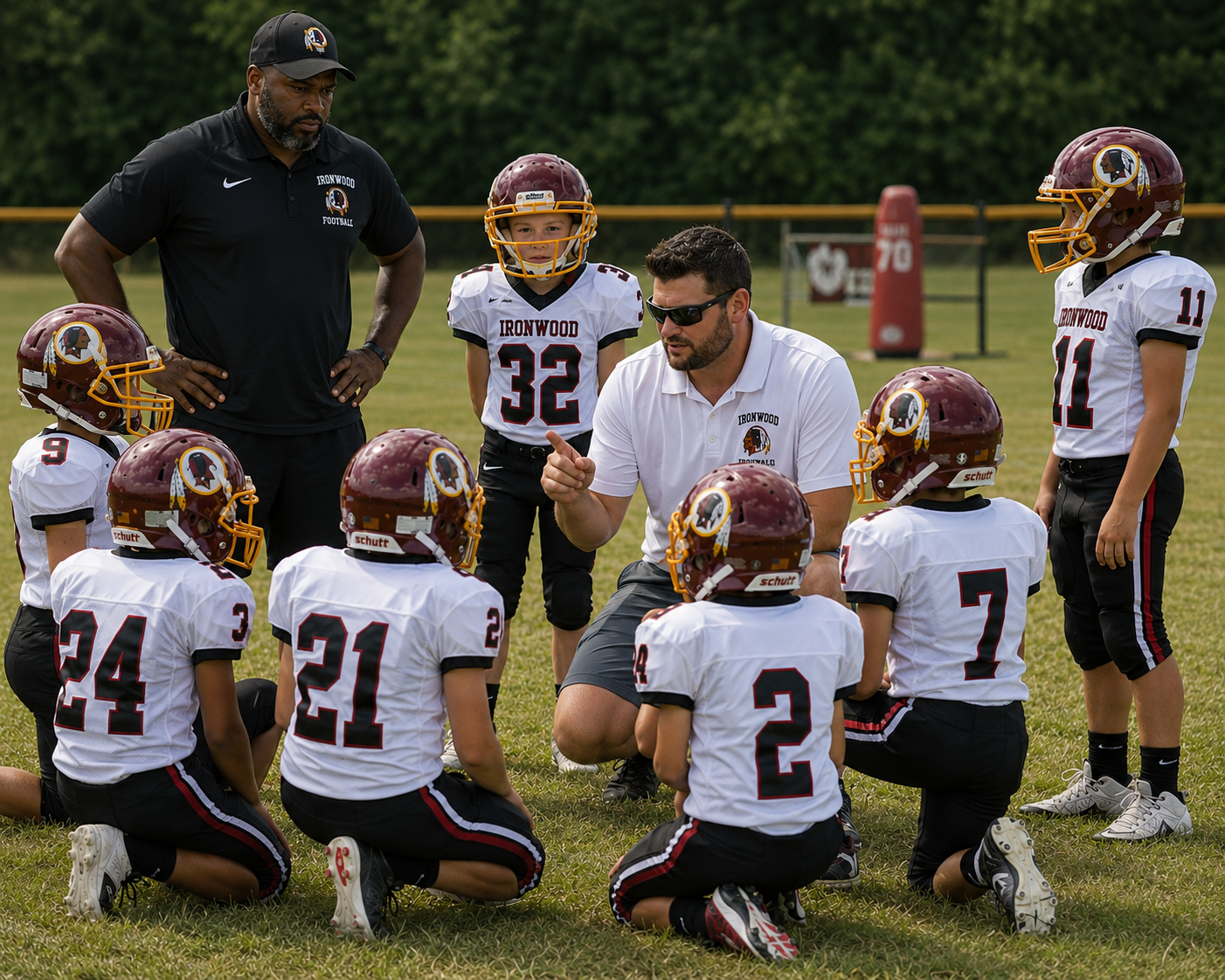
A youth football team gathers around two coaches during a focused practice, capturing leadership where it actually gets built: through repetition, clear standards, accountability, communication, and preparation before the pressure arrives.
Leadership is easy to talk about when nothing is on fire. It is easy to sound composed when the numbers are good, the team is aligned, the customer is happy, and nobody is questioning the plan. The real test comes before the pressure ever arrives. Great organizations build people in advance. They train judgment before the decision matters. They build communication before conflict erupts. They teach responsibility before somebody has to carry it alone. They create standards before the moment arrives when everybody is tired, emotional, uncertain, or looking for somebody else to tell them what to do. That is what leadership actually is. It is preparation turned into performance.
Pressure Does Not Build Leadership. It Reveals It.
A football coach does not wait until fourth-and-goal to explain responsibility. A military unit does not begin teaching communication after the mission starts. A strong business does not discover leadership development the morning after a major client walks away. Pressure exposes whatever was already there.
If the organization has trained people to think, pressure reveals judgment. If it has trained people to communicate, pressure reveals clarity. If it has created dependency, pressure reveals hesitation. If every important decision has always traveled upward, the team will look upward again when the stakes become real.
That is why corporate leadership training, management development, and organizational development have to happen before the organization desperately needs them. Training is not decoration. It is preparation for the moment when preparation becomes expensive to lack.
Great Leaders Create More Leaders
Weak leadership collects dependency. Strong leadership creates capability.
A leader who has to answer every question may feel indispensable, but the organization is becoming fragile around them. A manager who solves every problem personally may look productive, but the team is learning not to think. A founder who constantly rescues everybody may believe they are protecting the company while quietly teaching the organization that nobody else can carry meaningful responsibility.
Real leadership develops people who can move without being dragged.
That requires standards, coaching, repetition, accountability, and the willingness to let people carry enough weight to become stronger. Every serious organization eventually reaches the same question: are we building people who can execute without constant supervision, or are we merely building a larger collection of people who wait for instructions?
The Drill Matters Because the Game Will Not Wait
There is a reason good coaches repeat fundamentals long after everybody understands them intellectually. Understanding something once does not make it available under pressure.
The body and mind have to know what to do when speed increases.
Organizations are no different. Communication has to be practiced. Decision-making has to be sharpened. Managers need experience correcting weak performance. Leaders need practice confronting problems directly. Teams need to understand what authority they actually possess. People need to know what the standard looks like before the environment becomes chaotic enough to tempt them away from it.
Corporate training should create that kind of readiness. The objective is not simply to expose people to good ideas. The objective is to make stronger behavior easier to access when nobody has time to search through notes from last quarter's seminar.
Accountability Has to Exist Before the Mistake
A lot of organizations try to create accountability after something goes wrong. That is late.
Accountability should be built into the culture before the failure. People should know what they own, what they can decide, what standard they are being measured against, and what happens when the standard is missed. Ambiguity may feel comfortable until the first real problem appears. Then everybody suddenly discovers that nobody knew exactly who was responsible.
Strong organizational leadership removes that ambiguity early.
Responsibility should have weight. Authority should have boundaries. Expectations should be clear enough that people can evaluate their own performance before somebody above them has to intervene.
When that exists, accountability becomes less personal and more operational. The question stops being, “Who can we blame?” and becomes, “What was the standard, who owned it, and what changes now?”
Communication Is a Performance Skill
Communication is often treated like personality. Some people are “good communicators.” Others are not.
That is lazy thinking.
Communication is a performance skill. It can be observed, trained, measured, refined, and made more precise. Leaders can become better at giving direction. Managers can become better at correcting behavior. Executives can become better at framing decisions. Teams can become better at disagreement. Salespeople can become better at understanding what a customer actually means rather than merely waiting for their turn to speak.
Neuro-Linguistic Programming can add another layer because language is not neutral. The way a problem is framed changes the way people think about it. The way expectations are communicated changes what people believe they are responsible for. The way a leader responds to resistance can either increase resistance or move the conversation forward.
In high-performing organizations, communication is not filler between decisions. Communication is one of the mechanisms through which decisions become real.
Leadership Development Should Increase the Weight People Can Carry
One of the simplest ways to measure leadership development is to ask whether the person can now carry more responsibility without becoming less effective.
Can the manager handle a larger team? Can the supervisor resolve more conflict without escalation? Can the executive tolerate uncertainty without becoming reactive? Can the employee make a meaningful decision without asking permission every ten minutes?
That is growth.
Leadership development should increase capacity. People become capable of carrying more complexity, more responsibility, more pressure, and more consequence while maintaining judgment.
That is why some of the most valuable leadership training does not feel glamorous. It looks like repetition, correction, difficult conversations, clearer standards, better decisions, and people gradually becoming harder to overwhelm.
Talent Without Discipline Is Expensive
Raw talent is attractive because it is visible. Someone is fast. Someone is persuasive. Someone is technically brilliant. Someone can sell. Someone can solve problems other people cannot solve.
Then the pressure increases.
Talent without discipline can become unpredictable. Talented people can become arrogant, reactive, inconsistent, resistant to coaching, or impossible to build around. The very thing that made them valuable begins creating organizational cost.
Great organizations do not simply collect talented people. They create structures that allow talent to compound instead of detonate.
That requires coaching, leadership, expectations, communication, and consequences. Talent becomes far more valuable when the person knows how to operate inside a team, carry responsibility, and remain effective when things stop going their way.
Great Organizations Build People Before They Promote Them
Promotion is one of the most common places where organizations confuse performance with readiness.
The best technician becomes the manager. The best salesperson becomes the sales leader. The strongest operator becomes the supervisor. The person was excellent at the old job, so the company assumes they will naturally be excellent at the next one.
Sometimes they are.
Sometimes the organization just took its best performer away from the work they were great at and handed them a completely different job they were never trained to do.
Leadership development should begin before promotion. People should learn how to communicate, delegate, coach, make decisions, handle conflict, and manage responsibility before everybody underneath them has to pay for the learning curve.
That is how succession becomes intentional instead of accidental.
Culture Is What People Do When the Leader Is Not Looking
Companies love talking about culture. The real definition is simpler.
Culture is what people repeatedly do when nobody important is standing there.
Do they solve the problem or hide it? Do they tell the truth upward? Do they protect the standard when it is inconvenient? Do they make the decision they were trained to make? Do they help each other? Do they take responsibility? Do they become passive the second somebody with more authority leaves the room?
That behavior tells you much more about culture than anything printed on a wall.
Organizational leadership becomes powerful when the standard is internalized deeply enough that people maintain it without constant enforcement.
That is the point of coaching. That is the point of training. That is the point of repetition.
Corporate Training Should Make the Organization Harder to Break
The strongest corporate training programs should create organizational resilience.
The company should become less vulnerable to one person's absence. Less vulnerable to conflict. Less vulnerable to pressure. Less vulnerable to a difficult client. Less vulnerable to an unexpected departure. Less vulnerable to one manager having a bad month.
That does not happen because people attended a seminar.
It happens because more people can think, communicate, decide, lead, and carry responsibility.
The organization gains depth.
That depth is an asset. It affects retention, execution, succession, customer experience, management, growth, and ultimately enterprise value.
Leadership Exists Everywhere
This is why organizational leadership is not confined to boardrooms.
It exists on football fields, construction sites, restaurant kitchens, military units, salons, warehouses, hospitals, sales floors, classrooms, factories, and family businesses. Any environment where people have to coordinate under pressure creates the need for leadership.
The uniforms change. The principles barely do.
People need standards. They need communication. They need accountability. They need competent authority. They need opportunities to develop. They need to know what they are responsible for when the moment becomes difficult.
Great organizations — of all ilks — understand this intuitively. They develop people before the stakes expose the cost of failing to do so.
Leadership Training in Syracuse, Manhattan, Kansas City, and Miami
Organizations in Syracuse, Manhattan and New York City, Kansas City, Miami, and markets across the country face different industries and different pressures, but the leadership challenge remains remarkably consistent. Companies need people who can think clearly, communicate precisely, execute reliably, and carry responsibility when conditions become difficult.
Corporate leadership training, management development, organizational development, executive coaching, and Neuro-Linguistic Programming business consulting can help build that capability deliberately instead of waiting for experience to create it accidentally.
The goal is not merely to produce more managers. The goal is to create more people capable of carrying the mission.
Build Them Before You Need Them
The worst time to discover your organization lacks leadership is when everybody is already looking for it.
Build people earlier.
Give them responsibility before the responsibility becomes enormous. Make them think before the decision becomes expensive. Correct communication before the misunderstanding costs a client. Develop managers before the team begins failing underneath them. Strengthen the organization while there is still enough room to train instead of merely react.
Pressure will eventually arrive.
It always does.
The question is whether your people will meet that pressure as individuals waiting for instructions or as an organization that has already learned how to execute.
Destiny Success and Development provides corporate leadership training, management development, organizational development, executive coaching, and Neuro-Linguistic Programming business consulting for organizations that want stronger people carrying greater responsibility with greater precision.
Your first conversation is always free. Schedule your free business screening with Destiny Success and Development today.