
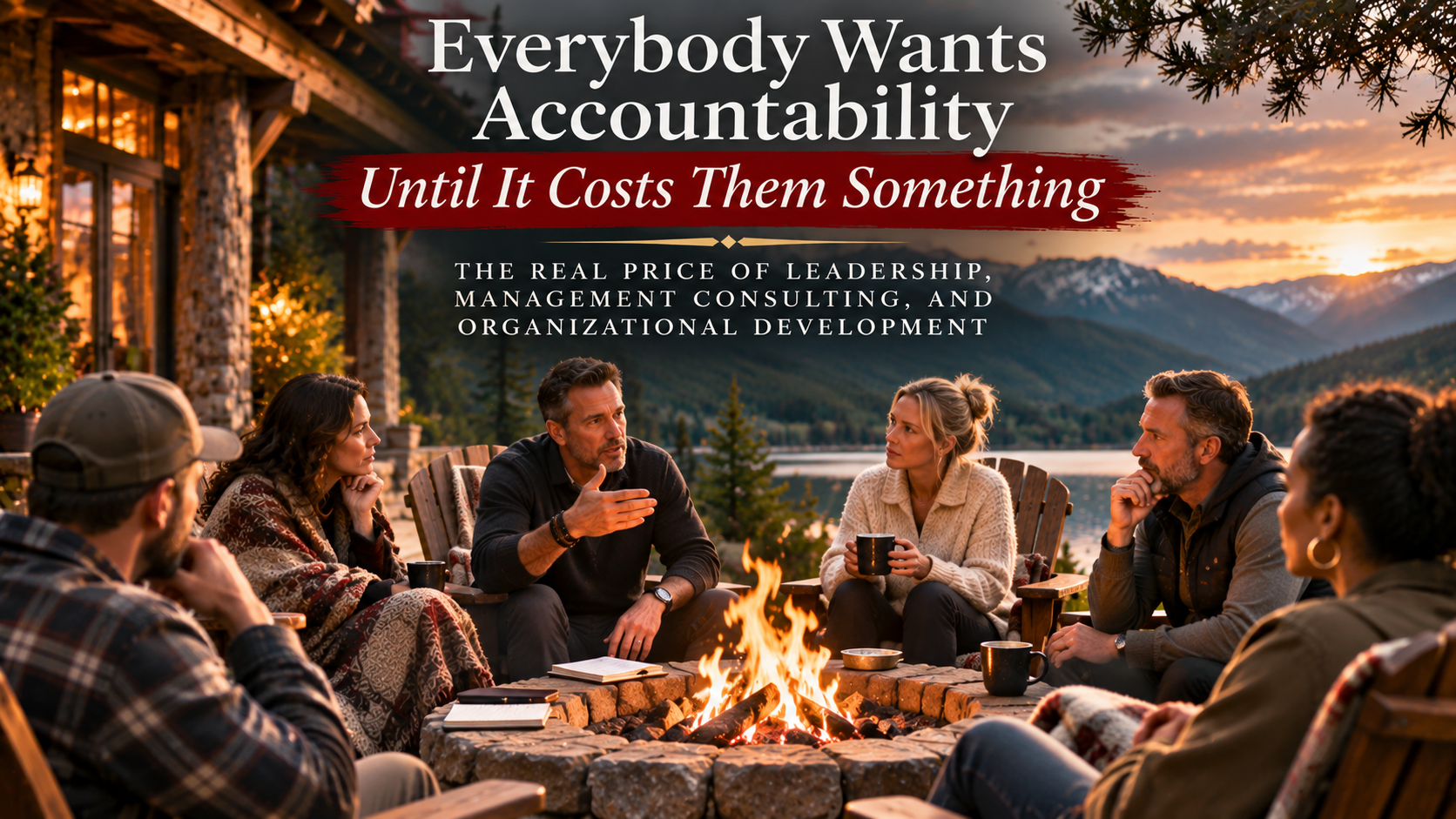
A group of executives and business leaders gathered around a fire at an upscale mountain retreat, engaged in a serious leadership discussion. The setting reflects executive accountability, leadership development, management consulting, organizational development, and the difficult decisions required to change a company.
Why leadership, management consulting, and organizational development only matter when someone is willing to make the expensive decision.
Accountability is one of those words executives love right up until it develops a price tag. It sounds great in a retreat, looks fantastic in a deck, and gets nods around the table when the stakes are theoretical. Then the real decision shows up, somebody important has to be confronted, a favorite manager has to be replaced, a bad hire has to be admitted, or a strategy has to be killed after six months of defending it.
That is where accountability stops being a value and starts becoming a test.
Most companies are not short on conversations about accountability. They are short on people willing to absorb the discomfort that comes with it. The difference matters because a business can talk about standards all day and still organize itself around avoiding consequences.
Accountability Gets Expensive Fast
The easy version of accountability is asking employees to hit deadlines, follow procedures, and explain missed numbers. The harder version is looking upward and asking whether leadership created the conditions that made those failures predictable.
Maybe the sales team missed the number because the market shifted. Maybe they missed it because the offer is weak. Maybe they missed it because the sales director is protected by the CEO, everyone knows it, and the rest of the team stopped believing performance actually matters.
That is the kind of problem a motivational speech will not solve.
Strong management consulting has to get underneath the visible failure and identify where authority, expectations, behavior, and consequences stopped lining up. If the organization says one thing and rewards another, employees learn the real system very quickly.
They always do.
The Company Usually Knows Where the Problem Is
In a surprising number of businesses, the central issue is not hidden. People know which manager cannot manage. They know which executive stalls decisions. They know which department is politically protected. They know which employee is carrying three people and which three people are surviving because somebody keeps carrying them.
What they do not know is whether anyone at the top is actually willing to do something about it.
That is where business consulting becomes useful. The outside perspective matters because people inside an organization become accustomed to dysfunction. What would look absurd to an outsider can start feeling normal after two years of meetings, excuses, exceptions, and workarounds.
Eventually, the workaround becomes the operating system.
Leadership Development Without Consequences Is Theater
There is nothing wrong with leadership training, executive coaching, or management development. The problem is what happens when those things are used as substitutes for decisions that should have already been made.
You can send a weak manager to six leadership programs. If they refuse feedback, avoid difficult conversations, lose strong employees, and continue being protected from consequences, the company does not have a training problem.
It has a leadership problem.
Real leadership development requires more than adding skills. It requires judgment. It requires the ability to recognize when a person can grow into the role and when the organization is simply prolonging a bad decision because correcting it would be uncomfortable.
There is a difference between development and denial.
Executive Judgment Is Where Accountability Becomes Real
At senior levels, accountability becomes more complicated because fewer people are willing to challenge the person making the call. The higher someone climbs, the easier it becomes to confuse agreement with accuracy.
That is dangerous.
A CEO can become insulated from bad news. A leadership team can quietly learn which subjects are safe and which subjects are not. People start editing themselves before meetings, and eventually the executive hears a cleaner version of the company than the one employees are actually working inside.
This is where executive development matters most. Not because executives need more confidence, but because they need better judgment under pressure, better tolerance for contradiction, and enough self-awareness to recognize when the organization has started protecting them from reality.
The most expensive leaders are often not the least intelligent. They are the ones nobody can correct.
Organizational Development Is About the System, Not the Slogan
Organizations become what they repeatedly tolerate.
If poor performance carries no consequence, poor performance spreads. If strong employees are rewarded with more work, resentment spreads. If political behavior gets results, politics spreads. If every difficult decision gets delayed until the problem becomes a crisis, crisis management becomes part of the culture.
That is why organizational development cannot be reduced to team-building exercises and annual retreats. The real work is examining how decisions get made, how managers are selected, how conflict is handled, how responsibility is assigned, and whether the company’s structure actually supports the behavior leadership says it wants.
Culture is not what leadership says in January.
Culture is what everybody watches leadership permit in March.
Management Development Has to Produce Managers Who Can Manage
A lot of companies promote people because they were excellent individual contributors. Then they act surprised when technical excellence does not automatically become leadership ability.
Managing people requires a completely different set of skills. Prioritization, delegation, conflict, standards, feedback, performance conversations, decision-making, and the ability to remain steady when somebody is unhappy are not small additions to the job.
They are the job.
Good management development identifies whether managers are actually capable of leading people or merely occupying management positions. It also helps leadership distinguish between someone who needs training and someone who is fundamentally wrong for the role.
That distinction can save a company years.
Business Strategy Fails When Nobody Owns the Decision
Many strategy problems are not strategy problems at all.
The company has a plan. The market opportunity is clear. The priorities have been discussed. Everyone can explain what is supposed to happen next.
Then nothing moves.
That usually means ownership is weak.
When five people are responsible, nobody is responsible. When every decision requires consensus, the organization slows down. When leaders avoid assigning clear ownership because they do not want conflict, the company creates ambiguity and then punishes people for operating inside it.
Strong business strategy consulting has to connect strategy with decision rights, accountability, and execution. Otherwise, strategy becomes another document people agree with and ignore.
A strategy without ownership is decoration.
The Most Important Decisions Usually Cost Something
Accountability costs comfort.
Sometimes it costs a relationship. Sometimes it costs money. Sometimes it costs a talented employee who refuses to operate within the system. Sometimes it costs an executive the ability to tell themselves the story they prefer.
That is why accountability is difficult.
The organizations that improve are not necessarily the ones with the smartest people in the room. They are the ones willing to make the decision after the room gets uncomfortable.
They remove the manager who should have been removed six months ago. They stop funding the initiative that is not working. They redesign the reporting structure. They confront the executive whose behavior is quietly damaging the company. They stop asking their best people to compensate indefinitely for everybody else.
That is what real intervention looks like.
Business Interventions Are Designed to Interrupt the Pattern
A business intervention becomes necessary when the company has already discussed the issue, already understands the symptoms, and still keeps recreating the same result.
That can happen because the problem is political. It can happen because leadership is emotionally invested in the wrong person. It can happen because the company has normalized behavior that should never have become normal.
The value of an intervention is not another explanation.
It is interruption.
The pattern has to be made visible, the cost has to be made clear, and the decision that everyone has been circling has to finally become difficult to avoid.
That is where management consulting, executive coaching, leadership development, and organizational development have real value. They help leadership stop treating repeated dysfunction as a mystery.
Management Consulting in Syracuse, New York
For companies in Syracuse and Central New York, management problems often become expensive because organizations stay patient too long. A leadership issue gets framed as a personality issue, a management failure gets blamed on workload, and accountability gets postponed in the name of keeping the peace.
Destiny Success and Development works with business owners, executives, and leadership teams on management consulting, leadership development, executive coaching, organizational development, business strategy consulting, and business interventions designed to address the issue underneath the issue.
The goal is not to create more meetings about the problem.
The goal is to change it.
Business Consulting in New York City, Kansas City, and Miami
The same problems show up in larger and faster-moving markets. In New York City, Kansas City, and Miami, the cost of weak management can grow quickly because complexity hides dysfunction for a while.
Revenue can disguise a bad structure. Growth can hide poor leadership. A strong market can keep weak managers employed longer than they should be.
Eventually, the bill comes due.
For companies looking for business consulting, management consulting, executive development, leadership development, organizational development, Neuro-Linguistic Programming business consulting, or business intervention services, the real question is not whether the company understands the problem.
The real question is whether leadership is finally ready to do something that changes the pattern.
Accountability Is Easy Until It Points Up
Every organization has standards until those standards become inconvenient.
That is the moment that tells you what the culture really is.
If accountability only travels downward, it is not accountability. It is hierarchy.
If leadership expects employees to face consequences while executives are insulated from them, the company eventually learns that performance is less important than position.
That is when strong people leave.
That is when political people thrive.
That is when the business starts looking healthier from the outside than it actually is.
Real accountability does not require cruelty. It requires clarity.
Who owns the decision?
Who owns the result?
What happens if the standard is missed?
And does that rule still apply when the person involved is powerful?
Those questions tell you more about a company than almost any mission statement ever will.
Your first conversation is always free. Schedule your free business screening with Destiny Success and Development today.