
Most companies do not need another diagnosis. They already know where it hurts.
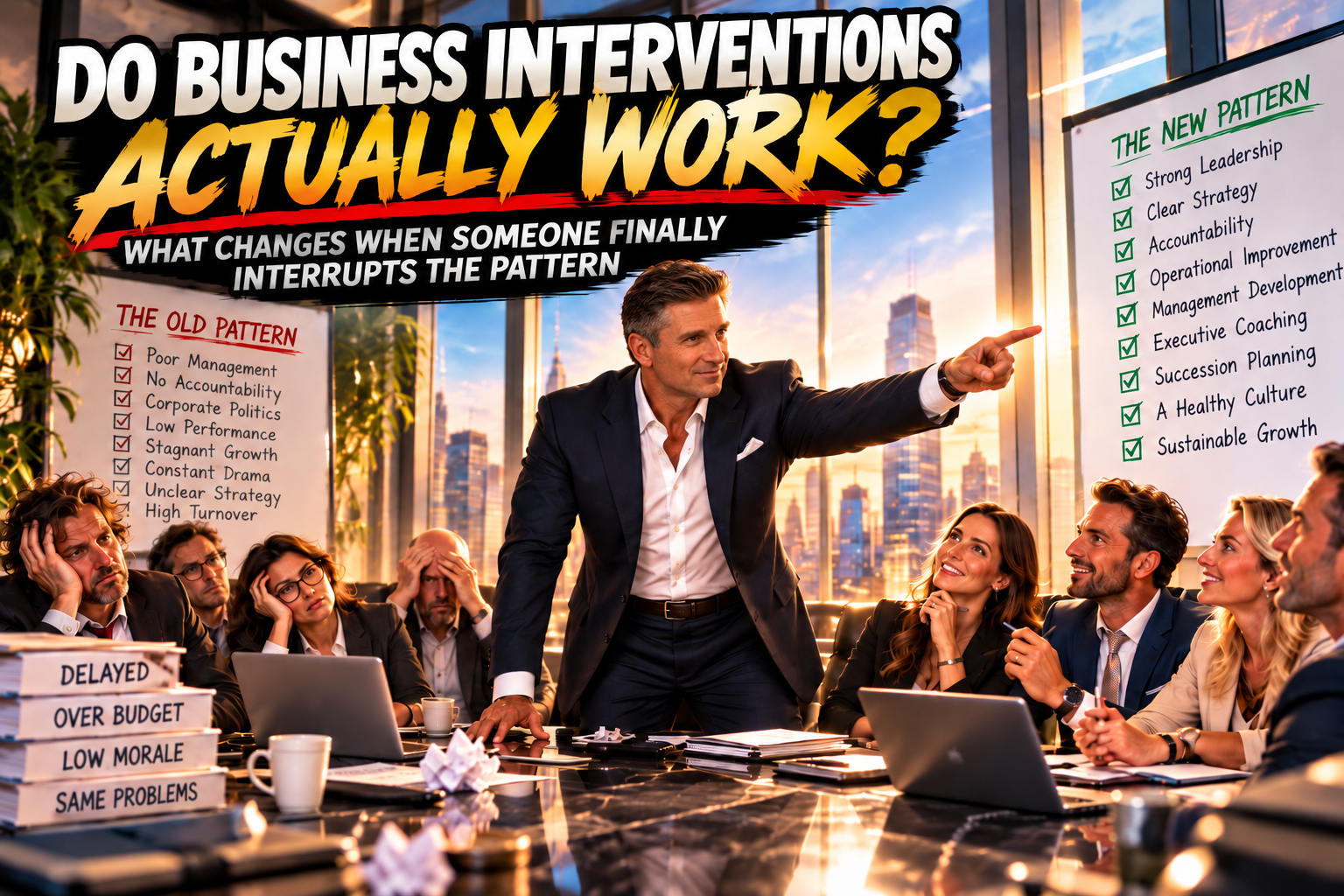
A confident business leader interrupts a dysfunctional corporate pattern and redirects the organization toward stronger leadership, clearer strategy, accountability, management development, and sustainable growth.
There is a particular kind of frustration that happens inside a business when everyone knows something is wrong and nothing actually changes. The meetings continue, the same people make the same promises, another quarter passes, and leadership somehow finds a more sophisticated vocabulary for describing exactly the same problem.
Maybe accountability is weak. Maybe managers cannot manage, the leadership team cannot make a clean decision, the strategy never survives contact with operations, or one executive has become so politically protected that the entire organization quietly works around them. Whatever the issue is, eventually another discussion about it becomes almost insulting.
That is when a business intervention becomes different from ordinary consulting. An intervention is not another conversation about the pattern; it is a deliberate disruption of the pattern itself.
At Destiny Success and Development, that distinction matters because businesses rarely become stuck from a complete absence of intelligence. They become stuck because intelligent people get trapped inside systems, relationships, habits, incentives, loyalties, power structures, and behaviors that the organization has gradually learned to tolerate.
A Business Intervention Begins Where Talking About It Stops Working
Most companies are already filled with people who can describe the problem. Ask privately and employees will tell you exactly which manager is failing, which department cannot execute, where decisions disappear, who actually has influence, which executive cannot be challenged, and what everyone pretends not to notice.
The knowledge exists, but knowledge does not automatically create movement. Organizations can understand themselves remarkably well and still remain completely incapable of interrupting their own behavior.
That is why effective management consulting cannot simply consist of observation and recommendations. If the consultant spends three months discovering what everyone in the company already knew and then puts it into a forty-seven-slide presentation, congratulations: the dysfunction now has excellent typography.
A real intervention changes something. It alters a decision, confronts a management problem, reorganizes accountability, exposes an informal power structure, develops a leader, clarifies authority, changes a communication pattern, removes a bottleneck, or forces an issue that the organization has repeatedly allowed itself to avoid.
Companies Develop Patterns Just Like People Do
Businesses like to imagine themselves as rational structures made of departments, job descriptions, policies, processes, and strategic plans. In reality, every organization also develops habits, emotional reactions, alliances, avoidance patterns, unwritten rules, and deeply conditioned ways of responding to pressure.
One company delays every difficult personnel decision until the damage becomes impossible to ignore. Another holds meetings about decisions instead of making decisions, while another lets the CEO interfere with every department and then wonders why nobody demonstrates initiative.
Some organizations reward firefighters while ignoring the people who prevent fires. Some protect charismatic executives, tolerate weak managers, promote technically excellent employees into leadership jobs they cannot perform, or allow their highest performers to compensate indefinitely for everybody else.
Repeat any of those patterns long enough and they stop looking dysfunctional. They simply become “how we do things here.”
That is precisely when an outside business intervention can become valuable. Someone has to see what the organization has stopped noticing.
The Most Dangerous Business Problems Often Look Normal From the Inside
Normalization is one of the reasons organizational dysfunction can survive for years. Human beings adapt quickly, and once employees have spent enough time accommodating a broken system, the accommodation itself begins looking like competent work.
The executive assistant knows which bad news can be delivered before lunch. The operations manager knows which sales promises are fictional, the leadership team knows which CEO idea cannot be questioned, and everyone knows which employee is technically accountable for a function but has no real authority over it.
Eventually the organization becomes extraordinarily skilled at navigating its own dysfunction. That skill can make the company look healthier than it actually is because talented people are constantly compensating for structural weakness.
This is where organizational development consulting has to go beneath the org chart. The formal organization tells you who is supposed to have authority; the real organization tells you who people trust, who controls information, who influences decisions, who gets protected, and who everyone calls when something actually needs to happen.
Management Problems Do Not Stay in Management
A weak manager does not create one isolated management problem. Weak management spreads downstream into turnover, inconsistency, poor communication, weak accountability, missed deadlines, political behavior, employee frustration, and senior executives becoming involved in decisions they should never have needed to touch.
That is why management development and management training matter far beyond teaching supervisors how to conduct better meetings. Managers are the transmission system between strategy and execution.
A brilliant executive team can create a beautiful strategy, but somebody still has to translate that strategy into priorities, expectations, decisions, conversations, standards, and daily behavior. If the management layer cannot do that, the strategy lives beautifully in PowerPoint while the organization continues operating exactly as it did before.
A serious business intervention therefore asks uncomfortable questions about management capability. Who can actually lead people, who merely has authority, which managers develop talent, which managers avoid conflict, and which managers have been protected from consequences because replacing them would be inconvenient?
Those questions can be uncomfortable. They can also save a company years.
Leadership Development Should Change Leadership
There is an entire industry built around making executives feel as though development occurred because they attended something expensive. They leave with a notebook, an assessment, perhaps a new vocabulary for discussing themselves, and then return Monday morning and behave exactly as they behaved Friday afternoon.
That is not leadership development. That is executive tourism.
Real development becomes visible in behavior. The leader delegates differently, communicates more clearly, stops rescuing weak managers, makes difficult decisions sooner, creates stronger accountability, becomes more aware of political consequences, and learns how their own behavior is shaping the organization around them.
This is where an intervention can become particularly powerful. Rather than asking whether the executive understands the concept intellectually, you examine what actually happens when pressure returns.
Anyone can discuss leadership beautifully when nothing important is at stake. Leadership becomes visible when the decision is expensive, the employee is politically connected, the client is angry, the numbers are disappointing, or the executive’s own ego is sitting directly in the middle of the problem.
Executive Coaching Should Produce Movement, Not Dependence
Good executive coaching should make an executive more capable, more perceptive, and increasingly able to operate without needing the coach standing beside every decision. Coaching that merely creates an endless relationship can become another comfortable ritual the organization mistakes for progress.
The objective should be sharper judgment, stronger self-awareness, better influence, cleaner communication, improved decision-making, and greater ability to see the consequences of one’s own leadership behavior. Insight matters, but insight without behavioral change is simply an interesting conversation.
A business intervention can accelerate this process because the executive is not being coached in an abstract vacuum. The work is connected to live organizational problems, real people, actual decisions, political realities, revenue, execution, and consequences.
That creates accountability. The question becomes less “What did you learn about yourself?” and more “What are you doing differently with the information?”
Strategy Usually Does Not Fail Because Nobody Had One
Organizations love strategy because strategy is elegant. It lives in decks, retreats, vision statements, annual plans, and beautifully designed documents describing where the company intends to be three years from now.
Execution is considerably less glamorous. Execution requires someone to decide who owns what, establish deadlines, allocate resources, confront resistance, remove weak performance, coordinate departments, and keep everybody focused after the excitement of the strategy meeting disappears.
This is why business strategy consulting cannot stop at designing the plan. If the organization lacks the management discipline, leadership alignment, organizational structure, and accountability required to execute the strategy, then another strategic plan merely gives the company a more sophisticated document to ignore.
A business intervention looks for the point where strategy repeatedly dies. Maybe sales is promising things operations cannot deliver, managers are protecting departmental interests, decisions are being escalated unnecessarily, or executives have never actually agreed about priorities.
Those are not strategy-document problems. Those are organizational behavior problems.
Accountability Is Not a Spreadsheet
Companies frequently claim they need more accountability when what they actually need is the courage to enforce the accountability they already designed. Everyone knows the metric, everybody understands the expectation, the deadline passes, performance misses, and somehow absolutely nothing happens.
That teaches the organization something very quickly. It teaches people which standards are real and which standards are decorative.
Accountability only exists when behavior has consequences. Those consequences do not always need to be punitive, but the organization must respond when commitments, standards, and responsibilities are repeatedly ignored.
A good management consulting intervention examines the complete accountability system. Are expectations clear, does the employee have authority to perform the role, are measurements meaningful, does leadership follow through, and are strong performers being forced to compensate for people who repeatedly fail?
If the answer to the last question is yes, the organization is not merely failing to hold somebody accountable. It is teaching its best people that excellence earns them additional work.
Corporate Politics Is Not Automatically the Enemy
The word “politics” gets used as though it describes something dirty that only dysfunctional organizations experience. Any environment involving human beings, resources, authority, status, competing interests, and limited opportunities will contain politics.
The question is whether those politics serve the organization or consume it. Healthy influence can move ideas, build coalitions, resolve differences, and create alignment; unhealthy politics protects weak performers, hides information, rewards loyalty over competence, and makes people calculate the personal consequences of telling the truth.
This is where Neuro-Linguistic Programming business consulting can become particularly useful because business communication is never simply about the words being spoken. Framing, language patterns, perception, emotional association, status, rapport, influence, interpretation, and the meaning attached to communication all affect how organizations respond.
A business intervention therefore cannot pretend that the company is a spreadsheet with humans attached. You have to understand the people operating inside the structure.
Sometimes the CEO Is the Pattern
There is an uncomfortable possibility that many consulting engagements dance around far too politely. Sometimes the biggest obstacle to organizational change is the person paying for the organizational change.
The CEO wants stronger managers but overrides their decisions. The CEO wants accountability but protects favorite employees, wants innovation but punishes failure, wants leadership development but cannot tolerate disagreement, or wants the company to stop depending on them while continuing to insert themselves into every meaningful decision.
No structural intervention can succeed for long if executive behavior continually recreates the old system. That is why executive development cannot be separated from organizational development when senior leadership is part of the pattern.
This does not require villainizing the executive. Many behaviors that become destructive at scale were exactly the behaviors that once made the leader successful.
The founder who personally controlled everything may have needed that intensity when the company had six people. The same behavior at sixty employees can suffocate managers, slow decisions, and turn the founder into the most expensive bottleneck in the organization.
Growth changes what leadership requires. Success does not excuse leaders from evolving with what they built.
Succession Planning Is an Intervention Before the Emergency
Few business problems are more predictable than succession problems. Everybody knows the founder will eventually leave, the CEO will eventually retire, key executives will eventually move on, and critical employees will not remain forever.
Yet companies routinely behave as though succession were a meteorological event nobody could have anticipated. The departure happens and suddenly leadership discovers that no one is ready, knowledge is concentrated in one person, relationships were never transferred, and the supposed successor has never been given enough authority to prove anything.
Good succession planning interrupts that pattern before the crisis arrives. It identifies critical roles, develops future leaders, transfers institutional knowledge, exposes talent gaps, and forces honest conversations about whether the person everyone assumes is next actually should be.
This is another reason interventions matter. Sometimes a business needs someone outside the internal relationships to ask the question everybody inside has learned not to ask.
Organizational Development Is Not About Making Everybody Comfortable
There is a soft, decorative version of organizational development that treats every problem as an opportunity for another workshop. That is not the version that changes businesses.
Real organizational development examines structure, leadership, communication, management capability, decision rights, accountability, culture, incentives, talent, workflow, conflict, and the informal systems influencing how the company actually functions. Sometimes the answer improves collaboration, and sometimes the answer is that somebody should no longer be in the job.
Both can be organizational development.
The goal is not universal comfort. The goal is creating an organization capable of performing better without consuming unnecessary human energy to accomplish ordinary work.
A healthy company can tolerate difficult conversations because the conversations are in service of clarity. An unhealthy company avoids them until the consequences become considerably more painful than the conversation would have been.
The Best Intervention Changes What Happens After the Consultant Leaves
There is an easy way to judge whether a business intervention mattered. Look at the organization after the intervention is over.
Are decisions happening faster? Are managers actually managing, is accountability clearer, are executives behaving differently, are fewer issues being escalated unnecessarily, and can employees explain the strategy in language that resembles what leadership thinks the strategy is?
Are strong performers still carrying weak systems? Are difficult conversations happening sooner, are meetings producing decisions, and has the company stopped repeatedly solving the same problem under different names?
Those are meaningful outcomes.
The consultant should not become another dependency that the organization has to maintain forever. The intervention should leave stronger capability behind.
Management Consulting in Syracuse, New York
For companies searching for management consulting in Syracuse, New York, business consultant Syracuse, business strategy consulting Syracuse, leadership development Syracuse, executive coaching Syracuse, organizational development Syracuse, or management training in Central New York, the local market creates its own dynamics. Longstanding business relationships, family companies, regional networks, legacy employees, and deeply established leadership structures can make change particularly personal.
That familiarity can be an advantage, but it can also protect patterns long after they stop serving the business. Everyone knows the history, everyone understands the relationships, and sometimes everyone knows exactly what the problem is while simultaneously understanding why nobody is allowed to touch it.
A well-designed intervention creates enough distance to examine those patterns without becoming trapped inside them. The purpose is not to disrespect history; it is to make sure history is not quietly running the company.
Management Consulting in New York City and Manhattan
In New York City and Manhattan, the scale, speed, status, competition, and complexity may look very different, but the underlying human patterns remain remarkably familiar. Executives still avoid difficult conversations, managers still struggle with accountability, organizational politics still influence decisions, and companies still confuse activity with execution.
The environment simply provides more expensive ways to hide it. Prestige, revenue, credentials, and intense workloads can make dysfunction look sophisticated for a surprisingly long time.
For companies looking for management consulting NYC, management consulting Manhattan, executive coaching New York City, leadership development NYC, business strategy consulting New York, or organizational development consulting, intervention work is often about separating genuine complexity from complexity the organization has created for itself.
Not every complicated business problem requires a complicated solution. Sometimes somebody simply needs to make the decision everyone else has been elegantly avoiding.
Management Consulting in Kansas City
In Kansas City, growth can expose weaknesses that smaller organizations were previously able to absorb. Informal communication stops scaling, founders cannot personally supervise everything, managers suddenly control larger teams, and departments that once coordinated through relationships now need actual systems.
That is where management consulting Kansas City, business consulting Kansas City, executive coaching Kansas City, leadership development Kansas City, and organizational development Kansas City become more than search terms. They represent the moment when growth requires the company to become more deliberate about management.
The intervention is not necessarily about changing the company’s identity. Often it is about preserving what made the company strong while replacing the behaviors that no longer scale.
Management Consulting in Miami and South Florida
In Miami and South Florida, entrepreneurial energy, rapid growth, international relationships, real estate, hospitality, healthcare, professional services, family businesses, and highly relationship-driven markets create another version of the same challenge. Charisma and momentum can carry a company surprisingly far before operational discipline becomes unavoidable.
For organizations searching for management consulting Miami, business consultant Miami, business strategy consulting South Florida, executive coaching Miami, leadership development Miami, or organizational development Miami, the intervention often begins where personality-driven success needs to become repeatable organizational capability.
A charismatic founder can create momentum. A mature company needs systems, managers, accountability, strategy, leadership depth, and decision-making that continue functioning when the founder is not personally standing in the room.
That transition can feel threatening because it requires leaders to surrender parts of the very control that originally helped them succeed. It is also how a business becomes larger than the personality that created it.
A Powerful Intervention Does Not Make the Company More Corporate
This is an important distinction because owners sometimes fear that professionalizing a business means sterilizing it. They picture bureaucracy, unnecessary meetings, management jargon, and six layers of approval before somebody can buy printer paper.
That is not the objective.
The objective is to remove friction that should never have existed. It is creating enough clarity that talented people can move faster, enough accountability that strong employees are not carrying everyone else, and enough management capability that senior executives can stop solving problems several organizational levels below them.
Good structure should create freedom. Good leadership should create capacity, and good management should make the business feel less complicated rather than more controlled.
That is what intervention work should produce.
The Company Does Not Need Another Conversation About the Pattern
There comes a point when analysis becomes avoidance. Everyone has discussed the manager, the executive, the turnover, the culture, the missed numbers, the succession problem, the strategy problem, the communication problem, or the department that somehow remains broken after its fourth reorganization.
Eventually somebody has to interrupt it.
That is what a real business intervention is for. It creates enough disruption to prevent the organization from simply returning to the same comfortable dysfunction after everybody agrees that something should probably change.
At Destiny Success and Development, our work through management consulting, business management consulting, business strategy consulting, leadership development, executive development, executive coaching, corporate leadership training, management development, organizational development, succession planning, and Neuro-Linguistic Programming business consulting is designed around that principle.
The goal is not to stand outside the company and describe the problem beautifully. The goal is to help leadership interrupt the pattern, strengthen the organization, and create changes that remain visible after the conversation ends.
Your first conversation is always free. Schedule your free business screening with Destiny Success and Development today.